What is VFNet?
vfnet.
All parts
- Training a classifier to detect redacted documents with fastai Sep 2021
- How to annotate image data for object detection with Prodigy Nov 2021
- What is VFNet? Nov 2021
- 73% accuracy for redaction object detection Dec 2021
- A Taxonomy of Redaction Dec 2021
- A Midway Report on my Computer Vision Project Jan 2022
- It's raining bboxes: how I wrote a Python script to create 2097 synthetic images to help improve my machine learning model Feb 2022
- Incremental Improvements to my Redaction Detection Model Mar 2022
- Figuring out why my object detection model is underperforming with FiftyOne, a great tool you probably haven't heard of Mar 2022
- 'I guess this is what data-centric AI is!': Performance boosts after training with synthetic data Apr 2022
- How to trust the data you feed your model: data validation with Great Expectations in a computer vision context (part 1) Apr 2022
- How to trust the data you feed your model: data validation with Great Expectations in a computer vision context (part 2) Apr 2022
- How to trust the data you feed your model: alternative data validation solutions in a computer vision context (part 3) Apr 2022
- A painless way to create an MVP demo using computer vision models May 2022
- More Data, More Problems: Using DVC to handle data versioning for a computer vision problem May 2022
- It takes a tribe: how I'm thinking about putting my object detection model into production May 2022
- Storing Bytes: what data serialisation is and why you need it for machine learning Sep 2022
VFNet is short for VariFocalNet. This method of object detection was first released in 2008 and it scored 55.1 on the COCO test-dev benchmark, state-of-the-art at the time. There have since been other improvements.
The original paper is here. The implementation of this model is here.
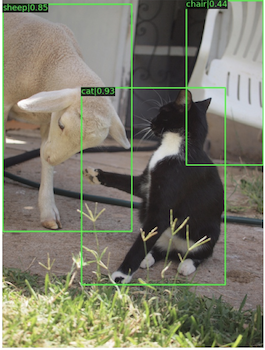
The problem it solves is that when we’re training a model, we have a large number of possible options for objects detected in an image. What we need to do is rank these options in order of likelihood of being a correct bounding of a box.
It is based on and draws on the MMDetection model/toolbox. MMDetection is a Pytorch library for object detection. It is modular, allowing for greater customisability.
Other resources
Get new posts by email
Every new post, technical and personal, sent when I publish. Unsubscribe any time. Prefer a feed reader? There's technical RSS and personal RSS.