Chondrichthyan Fun: a review of Shark MOOC
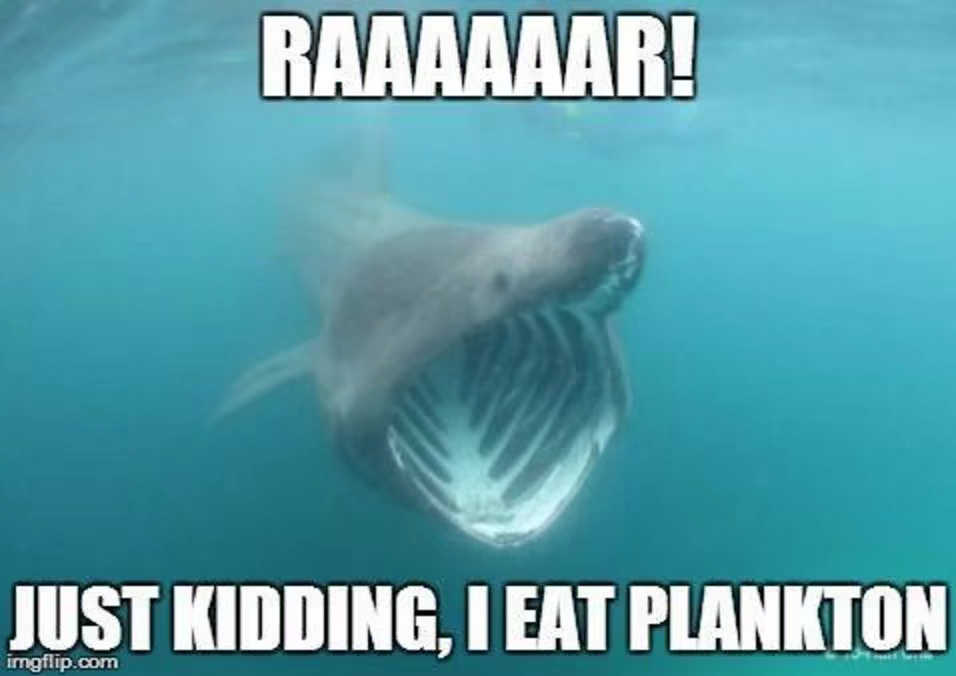
Everyone needs a good distraction. For the past four weeks, mine has been an online edX course run by the University of Cornell and the University of Queensland (Australia) entitled, Sharks! Global Diversity, Biology and Conservation. With my PhD newly submitted to external examiners and nothing to do but to wait until the oral viva examination, this was my reward to myself. The course would be a way to engage with the world in a different way, through the medium of biology, and maybe open myself to new possibilities.
I’ve been interested in ecology, environmental science and the hard sciences in general for a while, but as an outsider to the discipline, it’s hard to find a way in. This course (the “Shark MOOC”, as it became known) was a way to engage with biology, ecology and start to expose myself more to scientists doing their work.
I’ll spare you my raw enthusiasm for the course and tell you every fact I learnt about Chondrichthyes — yes, that’s the label that refers to sharks, rays, skates and a weird group of mainly deep-sea fishes called chimaeras. The course wasn’t really a deep dive into any aspect of shark biology, but surveyed the whole territory with moments of detail and depth. I learnt about:
- Shark Anatomy — this was presented in a decent amount of detail. I found it a bit overwhelming at the beginning, having to draw (and then test my recall again by redrawing the same diagrams without reference to books) shark brains, the different types of tails and so on.
- Shark Senses — did you know that sharks have two extra senses?!
- The Diversity of Shark Habitats and Behaviour — getting to know all of the different places where sharks hang out and what they do there, and the similarities and differences between all the different species.
- Palaeontology — we examined old fossils of sharks and rays, connecting us to this group of ancient fishes that predates (and mostly outlived the extinction of) the big dinosaurs.
- Ecology — the final week of the course was wise to connect the particularities of what we had just been studying (i.e. sharks and rays and their anatomy and such) to the bigger picture of ecosystems, conservation, ethical questions around shark ‘ecotourism’, the realities of what industrial fishing has done to shark populations and so on. This way, the detail of previous weeks brought us to a deeper understanding of topics and issues that otherwise might have only been covered superficially.
- Mythology — the course blended in a lot of ‘mythbusting’, since media and entertainment have shaped the way most of us (including yours truly, prior to taking this course) think about sharks. It was fascinating to explore how this demonisation had played out (since the release of Jaws in 1975/6) in public debate and understanding.
The course was mainly taught by William E. Bemis, Professor of Ecology and Evolutionary Biology at Cornell University, and Joshua Moyer, a research technician at Cornell University. Both transmitted great enthusiasm for their subject to their students and seemed to have an endless list of friends and colleagues on speed-dial from whom students got to learn. This was one of the best things about the course, the fact that we got to (virtually) hang out in so many different countries, with so many different scientists, both under the water and back in the lab.
I knew nothing about nothing when it came to sharks before the course, and so I was surprised to learn that there is a very active enthusiasm for the study of Chondrichthyes in the USA, especially among children. There were primary-school-age students participating in course discussion forums, and this was great to see. I learnt about the activities of The Gills Club, a “STEM-based education initiative dedicated to connecting girls with female scientists from around the world, sharing knowledge, and inspiring shark and ocean conservation”. What a great initiative!
Most of the course was presented through videos and/or text with diagrams and photos. Having taken a number of other MOOCs, I know that two of the challenges in teaching people through this medium are (a) keeping it interesting and (b) making sure that learning is active where possible. There were some multiple choice questions which formed the entirety of the course assessment, but they covered only a tiny fraction of the material being taught and were sometimes oddly worded.
Nevertheless, it came as no surprise to me that the course authors took two years (and probably a decent amount of money) to develop the MOOC, film all the different interviews and lessons and so on. It was well worth it, and I hope whoever funded the project will consider this a really worthwhile investment as something that can inspire a new generation of scientists.
If you study a course like this on your own, you have to find ways to make the learning process active. For me, this included:
- adding important concepts, anatomy diagrams and new words into Anki in order to test myself throughout. (If you haven’t heard of Anki before, it is software that uses a spaced repetition algorithm to super-charge your learning and retention of information into the long-term. I consider it an essential piece in the toolkit of anyone studying anything in the twenty-first century. Check out more here.) Anki’s useful stats and charts tells me that I added 289 cards relating to the course, most of which are now headed into my long-term memory courtesy of the spaced-repetition algorithm.
- drawing and redrawing diagrams of anatomy or timelines or whatever it was that I was studying. Where possible I tried to find a way to keep it visual. All of my notes were taken by hand, something I’ve been doing more and more recently after studies have shown it can help recall.
- talking to other people about Chondrichthyes. Explaining the lessons I’d been studying on a particular day was fun to do and it meant my brain got another chance to synthesise the material. Teaching newly-learned concepts to others is a great way to do this.
- finding other ways to deepen my exposure to the material and concepts being studied. I immersed myself in documentaries and fictional representations of sharks and rays. Luckily, there is a real richness available here, from the semi-numinous expience of the BBC’s 2015 three-parter Sharkto the no-less entertaining Sharknado quadrilogy.
I learnt on the first day of the course that there are sharks with twitter accounts. OCEARCH is one organisation (profiled in the New Yorker back in 2013) that attaches real-time satellite trackers to sharks. You can go to their website to follow the movements of a bunch of different sharks, most of whom are given cutesy names like Carolina or Johnny.
We were instructed to pick a shark and follow her throughout the weeks that followed. I selected a female white shark called Katharine (watch her being tagged in this video) and saw as she swam up the Eastern coast of the USA. Last time she surfaced she was headed out into the Atlantic ocean. (As a reminder of the realities of industrial fishing, some of the sharks chosen by fellow students ended up ‘pinging’ in their signals from fishing docks in west Africa or east Asia after being caught and killed, probably for their fins but possibly just as so-called ‘bycatch’).
It was fun to get to know a new community of enthusiasts for the study of a particular topic. I had deleted my @strickvl twitter account a few months back, frustrated by the noise:signal ratio and generally finding less and less reason to justify ‘keeping up with the news’. This shark course, though, saw me a bit more active on my (previously entirely passively-tweeted) @stricklinks account. I discovered fellow Chondrichthyes scientists, photographers and institutions this way and I was reminded of what Twitter felt like back in 2008 when I first joined. It was a place to meet other people, to find people who shared the same interests (back then I was all-Kandahar-all-day-all-night) around the world, to connect and cross-pollinate in a way whose speed was impossible even decades before. I think this is one of the best uses for twitter: in the beginnings of an interest in a topic, you can use it to generate a community round you, to find others who can inspire and drive you forward into learning more, people who can challenge your assumptions and model best practices in their fields.
As you can probably see, I found the course incredibly stimulating. I’m not sure my future is in marine biology (who knows?), but I’ve taken away a far greater appreciation for the ocean, the creatures in it and the beginnings of an understanding of how all of this starts to fit together: the history of how species grow and develop, the interactions between species, the threats and challenges to this whole system…
For now, though, I’d strongly recommend anyone with even a passing interest in science or in the ocean or in sharks to enroll in this course. It’s free, immensely entertaining and enriching and who knows where it will take you.